- Home ›
- Activities ›
- Blue Crabbing
FTC Disclosure: If you make a purchase via a link on this site, I may receive a small commission on the transaction - at no added cost to you. Thank you!
Catching Blue Crabs on Cape Cod
"Catch & Cook" Blue Claw Crab Fishing
Updated: July 25, 2021
For many of us who live on the eastern shoreline of the USA, catching blue crabs for dinner is as much a part of summer as a day at the beach.
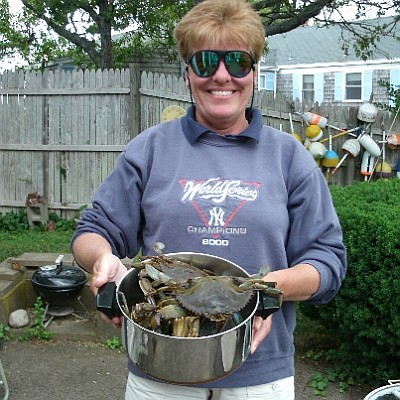 We had a great day blue crab catching!
If you've never caught and cooked your own crab dinner ... come to Cape Cod and try it, you'll like it!
Blue Crab Season on Cape Cod
In Massachusetts, crabbing begins on the 1st of May and continues through December 31st. The season is closed from January to the end of April.
As a practical matter, though, prime time to catch blue crabs here on Cape Cod is during the summer months: June, July, August and September.
That's when the Atlantic blue crabs are most active in our southern Massachusetts waters. It's also when the water temps are warm enough that you won't freeze your knees if you wade in to catch the tasty little critters!
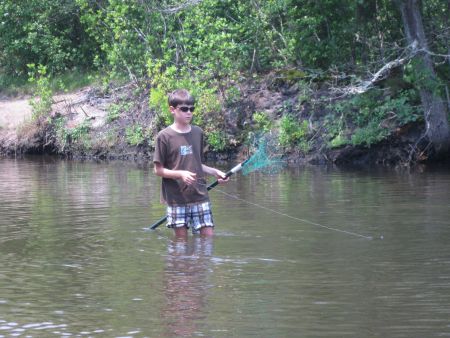 A beautiful summer day at Crab Creek Conservation Area
Crabbing Equipment
What makes this such a wonderful outing for the whole family is it's fun, it's free, and no fancy crabbing equipment is required. Just a long-handled dip net, a bucket, and maybe some raw chicken parts and a length of string.
*Note: No special permit is necessary in Massachusetts, as long as you're not planning to use a full crab trap and you're only keeping your catch for personal consumption. (Before you go crabbing, please check out the Recreational Crabbing Regulations at the end of this page so you'll know the rules!)
How to Catch Blue Claw Crabs
1. "Walk and Stalk" Crabbing
All you need to do is take your dip net in hand, walk slowly along through the water, and when you see a crab - scoop it up.
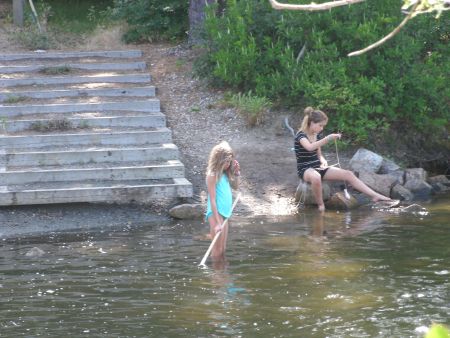 Stalking crabs in shallow water
- Tip: To be successful with this method, you need to be very stealthy. That means treading as quietly as you can through the water, and slowly easing your net down into the water so you don't spook the little guy.
Oh, and don't forget - when a crab scoots off, it goes sideways. The real trick is anticipating which way it'll go and having your net in the right spot! - What You'll Need: A dip net, a bucket, and a measuring device (to be sure crabs are legal size to keep). And wearing the right crabbing attire is always a good idea, too!
- Optional: You can also use this method from a kayak, canoe or small inflatible boat. You'll stay dry, and it's easier to sneak up on them when your feet aren't making a ruckus in the water.
2. "Scoop 'Em from the Current" Crabbing
This is my favorite way of catching blue crabs ... although I'll admit, it's not quite as sporting as the walk-and-stalk method.
To catch 'em in the current, head out to a tidal stream or an inlet where the current is moving. Take your dip net or fishing net, wade to the edge of the current flow, and wait for the crabs to come floating to you.
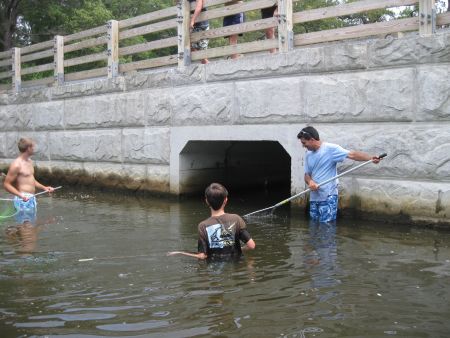 Waiting for the "blues" to float through!
- Tip: The smaller blue crabs tend to float along on top of the water, while the larger ones usually swim a little deeper. A good pair of polarized sunglasses helps immensely to see the bigger crabs under the surface!
- What You'll Need: A dip net or medium-sized fishing net, a bucket, and a measuring device
- Optional and Recommended: A daily tide chart to help you figure out the approximate time of high and low tide in the area you'll be crabbing.
We usually have the best success during the hour or so after the tide has turned, when the current is starting to run pretty swiftly.
3. "Chicken on a String" Crabbing
It's amazing what you can accomplish with a couple pieces of raw chicken and some string ...
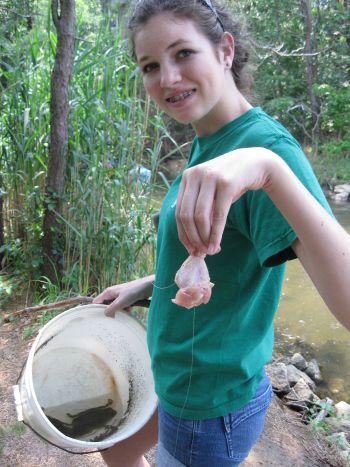 This chicken on a string thing really works!
Just tie a hunk of raw chicken (we use legs, others prefer necks) on the end of a long piece of heavy string or fishing line. Then toss the chicken into the water, holding tight to the other end of the string/line, of course!
Now, let your bait settle to the bottom, and take up the "slack" from your line.
In no time, you'll feel a little tug, tug, tug. That's the crab, grabbing hold and chomping on your offering.
With your net at the ready, very sloooooooowly ease your bait - with the crab still hanging on - up toward the surface. Slide the net under your bounty and scoop it up!
- Tip: You can do the chicken-on-a-string thing from stream banks, from fishing piers, from rock jetties, from a canoe or kayak, or by wading into the water. It all depends on how wet you want to get!
- What You'll Need: Chicken parts, heavy string or fishing line, dip net, measuring device, bucket
Keeping Your Catch Alive ... Temporarily ;-)
You've caught 'em. Now, how do you keep them alive until cooking time?
Don't leave your blue crabs in a bucket filled with water!!! They'll drown.
I know that seems odd. Water is a crab's natural habitat, after all. The difference is:
- In a creek, a stream, a bay, or any other large body of water, there's plenty of oxygen for the crabbies to breathe.
- In a small bucket of water, they quickly use up all the available oxygen ... and off they go to crab heaven.
(FYI: Your catch must be alive at cooking time. Dead crabs = bacteria. Not a good thing!)
To keep your freshly caught crabs alive and lively, put them in an empty bucket and set them in the shade. Kept out of direct sunlight, they'll be fine for several hours.
Where to Go Crabbing on Cape Cod
There's a good number of fairly reliable spots for catching blue crabs in the Upper and Middle Cape regions, from Falmouth to Dennis.
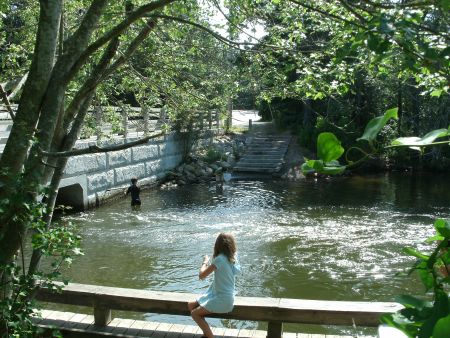 A favorite spot for catching blue claw crabs!
As you might suspect, my fellow Cape Cod crabbers would not be too happy with me if I gave up all the hot spots we've worked for years to find.
But, I'm not going to leave you entirely in the dark, either! So here are a few places you might want to try:
- Waquoit Bay - This beautiful location in East Falmouth is a great spot for crabbing, especially if you bring or rent a kayak or canoe. Overall, Waquoit Bay is relatively shallow and the water's usually pretty calm. And there are lots of pretty little estuaries to paddle, where you'll have a good chance of finding some blue crabs hiding out. While you're out on Waquoit Bay, consider heading over to Washburn Island if the wind and weather permit. Washburn Island is a gorgeous nature reserve that's only reachable by boat. A "don't miss", IMHO!
- Crab Creek Conservation Area - The area known as "Crab Creek" is at the northern end of the Bass River, on North Dennis Road in Yarmouth.If you're staying in the Mid-Cape area, Crab Creek is an easy spot to get to by car from any of the Cape's three major roads (Rt. 6, Rt. 6A or Rt. 28). There's a fishing/crabbing platform at Crab Creek, along with easy access to the water for those of you who prefer to wade.
- Craigville Beach Area - Craigville is one of the most well-known Hyannis area beaches, and it's especially popular with the teen and young adult set for sunning, swimming and socializing. When you're going to Craigville Beach for the day, why not bring your crabbing equipment with you? The Centerville River, a tidal river that runs just to the west of Craigville Beach, has given up many yummy crab feasts over the years!
MA Blue Crab Regulations
Here's a summary of the rules and regs for recreational blue crabbing in Massachusetts:
- Minimum size - 5” shell width (spine to spine)
- Egg-bearing females cannot be taken
- 25 crabs per day maximum
- No permit required for dip-netting and hand-lining;
- Closed season is 1/1–4/30, inclusive.
Click here for the current Massachusetts shellfishing laws and regulations.
Related Pages:
Crabbin' Clothes
Cooking Blue Crab the Quick and Easy Way
Digging Your Own Clams on Cape Cod
- Home ›
- Activities ›
- Blue Crabbing
Search This Site
FTC Disclosure: If you make a purchase via a link on this site, I may receive a small commission on the transaction - at no added cost to you. Thank you!
Recent Articles


-
Cape Cod Events Calendar: Fairs, Festivals & More in April 2024
Which April 2024 Cape Cod events should be on your don't-miss list? See my events calendar for this month's best local fairs, festivals, and special ... -
Best, Easy-to-Access Herring Runs on Cape Cod: Where & When to Visit
Cape Cod has dozens of herring runs. Some are easy to get to, others not so much. Here's where to find the best runs and when to go for the best chance to ... -
Cape Cod Events: Fun Things to See & Do on The Cape in March 2024
What's on the Cape Cod events calendar in March 2024? The month begins with the annual Hyannis Marathon Weekend. Then the gala St. Patrick's Parade ...

Cape Days: Your Go To Cape Cod Guide SM
Copyright 2008-2024 - Doné R. ("Dee") Young
CapeDays.com
All rights reserved.
* As an Amazon Affiliate I earn from qualifying purchases. *
Privacy Policy | Terms of Use | FTC Disclosure | About | Contact | Site Map | Legal
Member of Yarmouth MA Chamber of Commerce